Post-Social Media
A guide to the future of finding connection and community online.
Not all that long ago, the ability to connect with everyone on the planet, share information and find the people and causes we truly care about was an exciting promise. For the first time in human history, we were not limited by physical location, background or time constraints; anyone with a working internet connection could go online and find their tribe.
When social media emerged in the early 2000s, it soon took over the task of community building on the internet. We created profiles, chatted with friends and strangers, started groups, and used feeds to stay updated on things we were into.
But soon reality caught up. The platforms that promised to connect us start- ed to capitalize on our desire for connection, belonging and curiosity. Al- gorithms started to control what we saw in our feeds, data was collected to improve advertising, and platforms were optimized to keep us attached to our screens.
Social media became the new television. It gave us a voice. It gave us reach. But it doesn’t exist to solve our problems.
Our desire to find community and connection hasn’t changed. Instead, it’s adapting to a new phase, the post-social media era: a future that’s emerg- ing from the learnings of the past 20 years of building communities online.
The following report is a close examination of what social media means to us today, and what the guiding principles of the future might look like. It’s writ- ten for – and from the perspective of – people who use the internet to bring people together.
Not all that long ago, the ability to connect with everyone on the planet, share information and find the people and causes we truly care about was an exciting promise. For the first time in human history, we were not limited by physical location, background or time constraints; anyone with a working internet connection could go online and find their tribe.
When social media emerged in the early 2000s, it soon took over the task of community building on the internet. We created profiles, chatted with friends and strangers, started groups, and used feeds to stay updated on things we were into.
But soon reality caught up. The platforms that promised to connect us start- ed to capitalize on our desire for connection, belonging and curiosity. Al- gorithms started to control what we saw in our feeds, data was collected to improve advertising, and platforms were optimized to keep us attached to our screens.
Social media became the new television. It gave us a voice. It gave us reach. But it doesn’t exist to solve our problems.
Our desire to find community and connection hasn’t changed. Instead, it’s adapting to a new phase, the post-social media era: a future that’s emerg- ing from the learnings of the past 20 years of building communities online.
The following report is a close examination of what social media means to us today, and what the guiding principles of the future might look like. It’s writ- ten for – and from the perspective of – people who use the internet to bring people together.


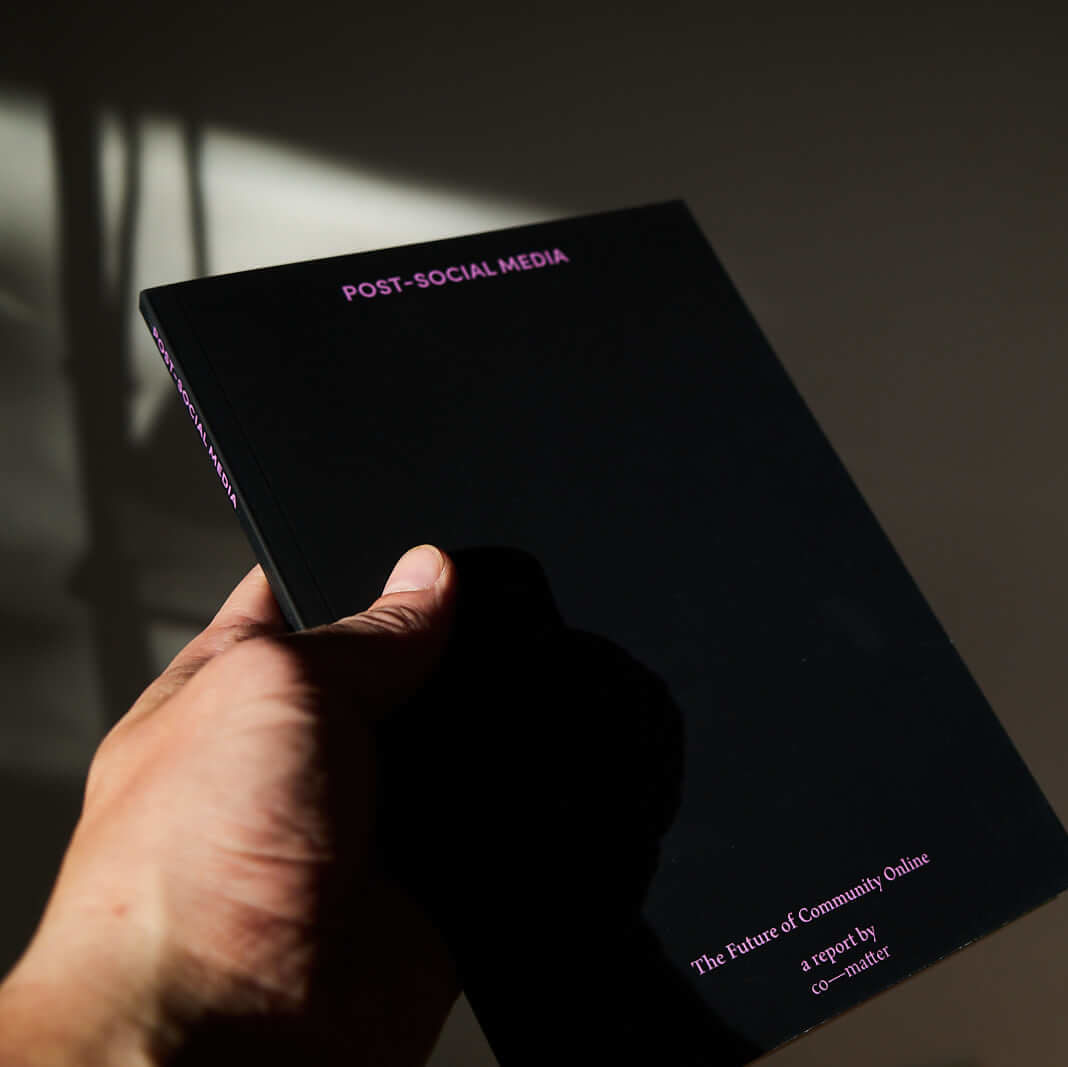
Community on the internet once seemed like the future. Now it has a past. Post-Social Media describes the shift in mindset and culture that is emerging in the wake of the social media era (2001-2020) and is both a reflection to social media’s downfalls, and a gateway to new forms of finding connection and belonging online.
Released by co—matter on September 22, 2020
Created and produced by co—matter
Free to read as PDF
Idea / creative direction: Severin Matusek
Editor: Anna Dorothea Ker
Art direction: Oh Boy Design
hello@co-matter.com
Zossener Str. 41
10961 Berlin
Management Board: Severin Matusek
Court of Registration: Amtsgericht Charlottenburg HRB 195395 B
VAT ID: DE317741247
Last updated: September 1 2026 ■ 09:57am